Gambling Addiction Q&A
Gambling has changed. What used to mean a trip to a casino is now a betting app in your pocket or a slot machine on your phone. Below, we answer the most common questions about problem gambling: the warning signs, the statistics, how it affects your finances, relationships, and mental health, and what actually helps when you want to stop. When you're ready, take our free Gambling Addiction Check (Takes 1-3 minutes, confidential, with instant results)
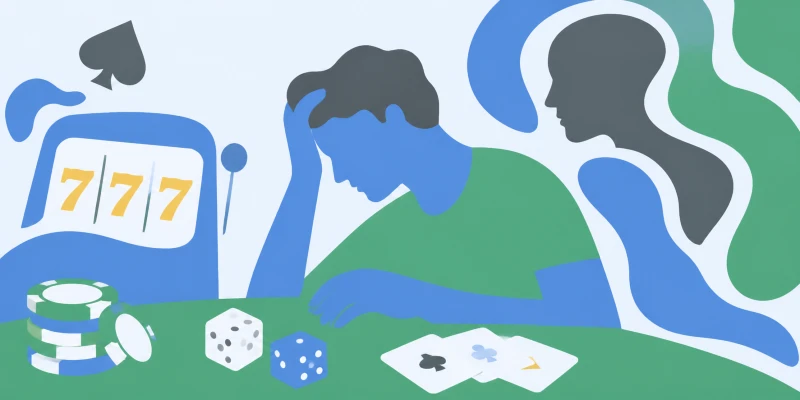
Gambling has grown explosively in recent years, fueled by online sports betting, casino apps, and even stock and crypto trading platforms that share many features with gambling. The numbers give a clear picture of how widespread problem gambling has become.
- Nearly 20 million U.S. adults report experiencing problem gambling behaviors, according to the National Council on Problem Gambling (NCPG).
- 10% of young men under 30 show signs of a gambling problem, more than three times the general population rate (FDU Poll).
- Sports betting has exploded. 1 in 4 young men now bets on sports online, and problem gambling rates doubled in states with legal sports betting (UCSD).
- Online casinos and slots are just as risky. Among problem gamblers, online sports betting (30%) and casino gaming (30%) are nearly tied as preferred formats (Kindbridge). Online slot players have the highest rate of problem gambling of any format.
- Day trading and crypto trading share key features with gambling: risking money on uncertain outcomes, variable rewards, and the potential for serious financial harm. Research shows a strong link between trading activity and problem gambling behavior (Journal of Gambling Studies).
- Parlay bets nearly doubled: 30% of sports bettors now use parlay wagers, up from 17% in 2018. This format is linked to more loss-chasing behavior (NCPG).
- Only 39% of Americans view gambling addiction as "very serious", compared to 62% for drug addiction and 55% for alcoholism (NCPG).
- Online gambling jumped from 15% to 22% of adults between 2018 and 2024, and online play is closely linked to higher risk (NCPG).
In Canada, about 60% of adults report spending money on some form of gambling each month, and the national gambling industry generated approximately $15.6 billion in revenue in 2025 (Industry data, 2025). A Statistics Canada study found that young men (18-34) are particularly vulnerable, with online sports betting and casino apps driving much of the recent growth (Statistics Canada, 2022). The CCSA has developed Lower-Risk Gambling Guidelines for Canadians, recommending limits on time, frequency, and spending to reduce gambling-related harms. These include guidelines such as gambling no more than 4 times per month and spending no more than 1% of household income on gambling.
Problem gambling is still widely underestimated as a public health issue. As access expands, so does the number of people affected. The WHO and DSM-5 both recognize gambling disorder as a behavioral addiction, classified alongside substance use disorders, which underscores how seriously these patterns should be taken.
If you're asking yourself this question, there's a good reason. Gambling addiction creeps up slowly. It doesn't usually start with a big loss. It starts with small wins, the excitement of a close call, and the feeling that "one more bet" could change everything.
Gambling addiction, clinically known as gambling disorder, is recognized by the DSM-5 (Diagnostic and Statistical Manual of Mental Disorders) as a behavioral addiction. Unlike substance addictions, there's no chemical entering your body, but the effects on your brain are strikingly similar.
Here are some signs that point toward a gambling problem:
- You often gamble with more money than you intended
- You've tried to cut back or stop and couldn't
- You feel restless or irritable when you try to cut down
- You gamble to escape stress, anxiety, or negative feelings
- After losing, you chase your losses by betting more
- You lie to family or friends about how much you gamble
- You've borrowed money or sold things to fund gambling
- Gambling has hurt your relationships, work, or finances
If several of these ring true, you may be experiencing problem gambling. Our Gambling Check can give you a clearer picture.
Gambling addiction shows up in specific behavioral and emotional patterns. The DSM-5 lists nine diagnostic criteria: meeting four or more in a 12-month period indicates a gambling disorder.
Common warning signs:
- Needing to bet more to get the same excitement (increasing tolerance)
- Restlessness or irritability when trying to cut down or stop
- Repeated failed attempts to control, cut back, or stop gambling
- Preoccupation: constantly thinking about gambling, planning the next bet, or reliving past wins
- Gambling when distressed: using it as an escape from feeling helpless, guilty, anxious, or depressed
- Chasing losses: returning the next day to win back what you lost
- Lying to family, friends, or therapists to hide your gambling
- Risky behavior: gambling with money you can't afford to lose, or borrowing money to gamble
- Relying on others to bail you out financially because of gambling losses
The more signs you recognize, the more worth paying attention to them. Our Gambling Check offers a structured way to reflect on your experiences.
Sports betting feels different from going to a casino. It's on your phone, it's integrated with watching games, and it's heavily advertised as a normal part of being a fan. That makes it easy to overlook when it crosses a line.
Signs that sports betting might be a problem:
- You can't watch a game without having money on it; the game feels "boring" without a bet
- You check betting apps constantly, even when you're at work or with others
- You've started betting on sports you don't even care about
- You use in-play (live) betting to chase losses during a game
- You've hidden betting apps from your partner or family
- You bet more than you planned because a parlay looked "too good to pass up"
- Your mood during a game depends entirely on whether your bet wins
According to a Fairleigh Dickinson University poll, 1 in 4 men under 30 now bets on sports online, and 10% show signs of problem gambling. The accessibility of mobile betting makes it uniquely risky.
This is the most visible impact of problem gambling and often the first sign that something is wrong. But it's not just about losing money. It's about how the relationship with money changes. This applies whether you're betting on sports, playing online slots, or day trading stocks and crypto.
Spiraling losses. Problem gambling rarely stays at the same level. People typically bet more over time, both because of tolerance (needing larger bets for the same thrill) and because of chasing losses (trying to recover money already lost).
Borrowing and debt. Many problem gamblers turn to credit cards, personal loans, payday lenders, or borrowing from family and friends. What starts as "just a small loan to get back on my feet" can snowball into serious debt.
Hidden spending. Problem gambling often involves secrecy. People hide losses, lie about winnings, and create elaborate stories to cover up where the money went.
What to watch for:
- Unexplained withdrawals from savings accounts
- Maxed-out credit cards or new credit lines opened
- Selling personal items for gambling money
- Missing bills, late payments, or utility shut-off notices
- Borrowing money you can't pay back
Financial problems from gambling can feel overwhelming, but there are resources: credit counseling, self-exclusion programs, and financial planning services specifically for gambling-related debt.
Gambling addiction is often called a "hidden addiction" because it doesn't leave physical traces like substance use. But the damage to relationships can be just as severe.
Trust erosion. Lying about gambling (where you were, how much you spent, whether you won or lost) breaks trust over time. Partners often report feeling more hurt by the lies than by the money lost.
Emotional distance. Preoccupation with gambling makes it hard to be present. You might be physically with your family but mentally calculating odds or checking betting apps. This emotional withdrawal hurts relationships deeply.
Conflict over money. Financial strain from gambling leads to arguments about spending, shared bills, and household budgets. In severe cases, it can lead to separation or divorce.
The National Council on Problem Gambling offers resources not just for gamblers, but also for their families and loved ones. You don't have to figure this out alone.
The relationship between gambling and mental health is a two-way street. Mental health struggles can drive gambling, and gambling can make mental health worse.
Anxiety and depression. Many people gamble to escape negative feelings like stress, anxiety, boredom, or sadness. The problem is that gambling creates new sources of stress: financial pressure, secrecy, guilt, and the cycle of chasing losses. What starts as a coping mechanism often ends up making things worse.
Insomnia and sleep problems. Late-night betting sessions, checking odds in bed, or lying awake worrying about losses are common. Poor sleep then makes it harder to regulate emotions, which increases the urge to gamble.
Shame and guilt. Problem gambling is deeply stigmatized. Many people feel intense shame about their losses, which makes them hide their behavior rather than seek help. This isolation feeds the addiction.
Suicide risk. Problem gamblers have a significantly higher risk of suicidal thoughts and attempts. If you're feeling this way, help is available: call 988 (Suicide & Crisis Lifeline) or 1-800-GAMBLER for immediate support.
Your mental health and your gambling are connected. Addressing one often helps with the other.
Gambling is often misunderstood because there's no substance involved. But the effect on the brain is remarkably similar to drug addiction.
The dopamine trap. When you gamble and win, or even come close to winning, your brain releases dopamine, the same chemical involved in substance addictions. The key insight from neuroscience research is that near-misses trigger almost the same dopamine response as actual wins. This is what makes slot machines, sports betting, and even rapid-fire crypto trading so compelling: your brain treats "almost winning" almost the same as winning.
Variable rewards. Gambling operates on what psychologists call a "variable ratio reinforcement schedule", the same mechanism that makes slot machines and social media addictive. You never know exactly when the next win will come, so you keep playing, waiting for it.
Tolerance builds. Just like with nicotine or alcohol, your brain adapts. The same bet that felt exciting a month ago no longer does. You need higher stakes, more frequent bets, or riskier wagers to get the same rush.
Withdrawal is real. When problem gamblers stop, they often experience irritability, restlessness, anxiety, and intense cravings, similar to withdrawal from substances. This is why quitting is harder than "just deciding to stop."
The good news is that your brain can heal. With time away from gambling, dopamine receptors gradually return to normal, and the intense urges fade.
This is one of the most common questions, and it's a fair one. Many people gamble occasionally without issues, whether it's betting on sports, playing slots, or trading stocks and crypto. So where's the line?
Casual gambling:
- Setting a budget and sticking to it
- Gambling as one activity among many, not the main event
- Walking away after a loss without feeling the urge to chase it
- Gambling doesn't affect your mood outside of the moment
- You can easily go weeks or months without gambling
Problem gambling:
- Spending more than planned, repeatedly
- Gambling becomes your main source of excitement
- After a loss, you immediately try to win it back
- Your mood is tied to whether you win or lose
- You feel anxious, restless, or irritable when you go without it
The key difference is control. If you've lost the ability to reliably set and stick to limits, or if gambling is causing harm and you continue anyway, it's moved beyond casual.
If you've told yourself "I'll just stop" and then found yourself betting again the next day, you're not weak. You're up against a brain that's been rewired.
It's not about willpower. Gambling addiction changes your brain chemistry. The part of your brain that weighs long-term consequences (the prefrontal cortex) gets overridden by the part that seeks immediate rewards (the limbic system). This isn't a character flaw. It's a neurological pattern.
Near-misses keep you hooked. Losing by one point, or getting two out of three legs of a parlay correct, triggers almost the same dopamine response as winning. Your brain interprets a near-miss as "almost there" and pushes you to try again.
The "sunk cost" trap. After losing money, your brain tells you that quitting means the losses were "for nothing." This logic keeps people gambling far longer than they intended, because stopping feels like admitting defeat.
Accessibility makes it worse. When the casino is in your pocket 24/7 through apps, there's no natural barrier. You don't have to drive to a casino or wait for a poker night. A bet is always one tap away.
Understanding these mechanisms doesn't make it easy to stop, but it does help explain why it's hard and why you need a strategy, not just willpower.
Gambling problems are often hidden. Unlike substance use, there's no smell, slurred speech, or physical signs, which makes it harder to spot but just as damaging.
Red flags to watch for:
- Unexplained financial problems: borrowing money, missing bills, selling belongings
- Secretive behavior with phone or computer: hiding screens, closing apps when you walk by
- Mood swings tied to sports games or lottery results
- Frequent mentions of "being due" for a win or "almost hitting it big"
- Withdrawal from family activities, especially at times when gambling is available
- Defensiveness or anger when asked about money or gambling
If you recognize these signs in someone close to you, the most helpful thing you can do is approach them with care, not confrontation. The National Council on Problem Gambling has resources specifically for families and loved ones of problem gamblers.
Quitting gambling is a process, not a single decision. Here are the approaches that work best, based on what's helped others.
Block access. Remove gambling apps from your phone. Use self-exclusion programs (most betting sites and casinos offer these). Install website blockers for gambling sites. Making it harder to gamble gives your rational brain time to catch up with your impulses.
Identify triggers. When do you feel the strongest urge to gamble? After a stressful day? When you're bored? When you've been drinking? Knowing your triggers helps you plan around them.
Find a replacement. Gambling filled a need: excitement, escape, social connection. Find something else that provides some of that. Exercise, gaming, a new hobby, or even just a walk can help fill the gap.
Try the 90-Second Urge Reset. Gambling urges feel intense but they usually peak and fade within a few minutes. Our 90-Second Urge Reset is a simple, guided breathing exercise designed to help you ride out the craving without acting on it.
Tell someone. Secrecy fuels addiction. Telling one trusted person (a partner, friend, therapist) breaks the isolation and creates accountability.
Use support groups. Gamblers Anonymous (GA) offers free, confidential peer support groups worldwide. Many people find that sharing experiences with others who understand makes a critical difference.
Get professional help. Cognitive Behavioral Therapy (CBT) is highly effective for gambling disorder. Many therapists now specialize in gambling addiction, and online therapy options make it more accessible than ever.
If you're concerned about your gambling, there are more resources available than most people realize, and many of them are free and confidential.
Support groups:
- Gamblers Anonymous (GA): free 12-step peer support meetings, available in person and online
- National Council on Problem Gambling (NCPG): information, self-assessment tools, and treatment referrals
Self-help tools:
- Self-exclusion programs: most states and betting platforms offer these (blocks you from gambling sites for a set period)
- Budget blocking apps: tools like Gamban and GamStop block gambling websites across all your devices
- Financial counseling: many organizations offer free budgeting and debt advice for gambling-related financial problems
Professional treatment:
- Cognitive Behavioral Therapy (CBT) is the most evidence-based treatment for gambling disorder
- Many therapists specialize in gambling addiction, with online and in-person options available
- Some states offer free or low-cost treatment programs for problem gambling
You don't have to figure this out alone. The fact that you're reading this page is already a step in the right direction.
Self-exclusion is a program that lets you voluntarily ban yourself from gambling sites, apps, or physical casinos for a set period (typically 6 months, 1 year, 5 years, or even permanently). It's one of the most practical tools available for problem gamblers.
How it works: You sign up with your state's self-exclusion program or directly through betting platforms. Casinos and online sites are legally required to deny you service and remove promotional offers during your exclusion period. In most states, trying to gamble while excluded can result in forfeiting any winnings.
Does it work? Research shows self-exclusion is most effective when combined with other support, like counseling, support groups, or financial planning. Alone, it's a barrier (not a cure), but it gives you valuable time to break the impulse loop. Many people find that the enforced break is long enough for cravings to subside and new habits to form.
Beyond self-exclusion: Tools like Gamban and GamStop block gambling content across all your devices. Most US states offer free self-exclusion programs. Check your state's gaming commission website or call 1-800-GAMBLER.