Gaming Addiction Q&A
Gaming is a bigger part of daily life than ever. What used to be a console in the living room is now a game in your pocket at any hour. Below, we answer the most common questions about gaming addiction: the warning signs, the statistics, how it affects your health, relationships, and daily life, and what actually helps when you want to regain balance. When you're ready, take our free Gaming Addiction Check (Takes 1-3 minutes, confidential, with instant results)
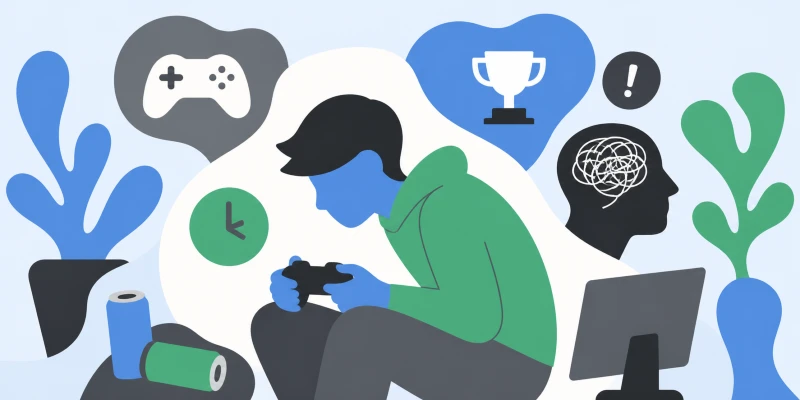
Gaming is one of the most popular forms of entertainment worldwide, but for a significant minority, it crosses into addiction. The numbers help show how big this issue really is.
- 3.3% of people worldwide experience gaming disorder, after adjusting for research bias. That's around 60 million people globally (meta-analysis, 2025).
- Among adolescents (12-18), the rate climbs to 8.5%. For young adults (15-34), it reaches 10.4%, the highest risk group (research review).
- The WHO officially recognizes gaming disorder in the ICD-11, classifying it alongside gambling disorder as a behavioral addiction (WHO).
- 61% of Americans play video games at least one hour per week, around 190 million people. The average player is 36 years old (ESA, 2024).
- Gaming disorder is more common in males. Studies consistently find that men and boys are 2 to 3 times more likely to develop problematic gaming patterns than women and girls.
- Loot boxes bridge gaming and gambling. About 40% of US adult gamers have encountered loot boxes, and their design exploits the same psychological mechanisms as slot machines (ScienceDaily).
- Online multiplayer games carry higher addiction risk than single-player games due to social pressure, daily rewards, and fear of missing out (FOMO) on limited-time events.
In Canada, gaming is equally popular. The ESA's data shows that Canadian gamers mirror US trends closely, with roughly the same proportion of the population playing regularly. The average Canadian gamer is in their mid-30s, and online multiplayer games are the most common format. The Canadian Centre on Substance Use and Addiction (CCSA) has examined gaming as part of its broader work on behavioral addictions, and Canadian addiction treatment programs increasingly recognize gaming disorder alongside other behavioral concerns.
Gaming addiction is real, clinically recognized, and affects millions. But the vast majority of gamers play without issues. It's about the relationship with gaming, not gaming itself.
If you're asking yourself this question, there's probably a reason. Gaming addiction doesn't usually start with a big dramatic moment. It creeps up slowly. A few extra hours here. Skipping one social plan there. Until one day, gaming is no longer something you do. It's something you feel you have to do.
The WHO defines gaming disorder by three core features: impaired control over gaming, increasing priority given to gaming over other activities, and continued gaming despite negative consequences (WHO).
Here are some signs that point toward a gaming problem:
- You regularly play longer than you intended
- You've tried to cut back and couldn't
- You feel restless, irritable, or anxious when you can't game
- You choose gaming over sleep, homework, work, or social plans
- You think about gaming even when you're not playing
- You hide how much you play from others
- You've neglected personal hygiene, eating, or exercise because of gaming
- Gaming has caused problems in your relationships or performance at school/work
If several of these ring true, you may be experiencing gaming disorder. Our Gaming Check can give you a clearer picture.
Gaming addiction shows up in specific behavioral patterns. The ICD-11 criteria focus on three main areas, but there are more specific warning signs to watch for.
Common warning signs:
- Loss of control. You set a time limit and regularly blow past it. "Just one more match" turns into three more hours.
- Gaming takes priority. You skip meals, stay up late, cancel plans, or miss deadlines to keep playing.
- Withdrawal-like symptoms. When you can't game, you feel irritable, restless, anxious, or have intense cravings to play.
- Tolerance. You need more gaming time or more intense gaming experiences to feel the same level of satisfaction.
- Escapism. You game to avoid real-life problems, stress, or negative emotions. Real life feels boring compared to the game world.
- Secrecy and defensiveness. You hide your gaming time, lie about how much you play, or get angry when someone brings it up.
- Neglect of responsibilities. School grades drop, work performance suffers, chores go undone, or bills get ignored.
- Physical effects. Eye strain, headaches, back or neck pain, carpal tunnel, sleep deprivation, and poor nutrition.
The more signs you recognize, the more worth paying attention to them. Our Gaming Check offers a structured way to reflect on your experiences.
Yes. Gaming disorder is officially recognized by the World Health Organization in the ICD-11, the global standard for diagnosing health conditions. It was added in 2019 after years of research showing that problematic gaming can cause real, measurable harm.
It's a common reaction to think "it's just games" or "everyone plays too much sometimes." The difference is functioning. If gaming is affecting your health, relationships, work, or school performance and you can't stop despite wanting to, it's moved beyond a hobby.
Critics argue that the diagnosis pathologizes normal behavior for passionate gamers. But the WHO is clear: gaming disorder only applies when the behavior is severe enough to cause significant impairment in personal, family, social, educational, or occupational functioning, and has been present for at least 12 months.
Think of it like drinking. Most people drink without problems. But for some, alcohol use becomes alcohol use disorder. Gaming works the same way.
Gaming addiction isn't just about lost time. It has real physical and mental health effects that many people don't connect to their gaming habits.
Sleep disruption. Late-night gaming is one of the most common patterns. Blue light from screens suppresses melatonin, and the mental stimulation of gaming makes it hard to wind down. Chronic sleep deprivation affects mood, focus, immune function, and long-term health.
Physical strain. Extended gaming sessions can cause eye strain (sometimes called "gamer eye"), headaches, neck and back pain from poor posture, and repetitive strain injuries like carpal tunnel syndrome.
Poor nutrition. Skipping meals, eating at the keyboard, or relying on energy drinks and snacks is common during long sessions. Over time, this can lead to weight gain, digestive issues, and nutritional deficiencies.
Mental health. Gaming addiction is strongly linked to anxiety, depression, and social isolation. It's often a cycle: mental health struggles drive more gaming, and more gaming worsens mental health.
What to watch for:
- Regularly sleeping fewer than 6 hours because of gaming
- Headaches or blurred vision after gaming sessions
- Persistent wrist, hand, or back pain
- Relying on caffeine or energy drinks to keep gaming
- Feeling more anxious or depressed the more you game
Gaming is often social. Many people play online with friends. But when gaming starts replacing real-world relationships instead of complementing them, problems can develop.
Neglect of loved ones. Partners, family, and close friends may feel ignored, second place to gaming. Common complaints include "you're always on that game" and "I feel like I'm competing with a screen for your attention."
Conflict over time. Arguments about how much time is spent gaming are one of the most common relationship issues linked to gaming addiction. This is especially true when gaming interferes with shared responsibilities.
Online vs offline. Heavy gamers sometimes find online relationships more rewarding than real ones. The game offers clear goals, immediate feedback, and a sense of achievement, which real-life relationships don't always provide as easily.
Gaming toxicity. Competitive online games can expose players to toxic behavior, harassment, and intense frustration that spills over into real-life mood and interactions.
Video games are designed to be engaging, and for good reason. They're built on psychological principles that tap directly into your brain's reward system.
The dopamine loop. Every time you level up, unlock a reward, win a match, or open a loot box, your brain releases dopamine. This is the same chemical involved in substance addictions and gambling. Games are carefully designed to provide these rewards at unpredictable intervals, which is the most addictive pattern (variable ratio reinforcement).
Near-misses and grinding. "Almost winning" a match, barely missing a rank-up, or grinding for a rare item triggers nearly the same dopamine response as actually getting it. This keeps you playing longer.
Fear of missing out (FOMO). Battle passes, daily login rewards, limited-time events, and seasonal content are designed to make you feel like you have to play regularly or you'll miss something permanently. This creates urgency and compulsion.
Loot boxes and gambling mechanics. Loot boxes are virtual containers with randomized rewards. They use the same psychological design as slot machines, and research shows they're linked to both gaming addiction and real-world gambling (ScienceDaily, 2025).
The good news is that your brain can rebalance. Taking breaks from gaming allows your dopamine receptors to reset, and the intense pull fades over time.
This is one of the most common questions among gamers. There's a big difference between being passionate about gaming and being addicted to it.
Passionate gaming looks like:
- You enjoy gaming and make time for it, but you can stop easily
- Gaming doesn't interfere with sleep, work, school, or relationships
- You play because you want to, not because you feel you have to
- Missing a gaming session doesn't cause anxiety or irritability
- You have other hobbies and interests outside of gaming
Problem gaming looks like:
- You regularly play longer than planned and can't stop
- Gaming is causing problems in your life, but you continue anyway
- You feel restless, irritable, or anxious when you can't play
- You've tried to cut back many times and failed
- Gaming is your main or only source of enjoyment
The key difference is control and consequences. If you can reliably set and stick to limits and gaming isn't causing harm, you're passionate. If you can't stop despite negative effects, it's crossed into problem territory.
If you've ever said "just one more game" and found yourself playing for three more hours, you know how hard it is to stop. It's not about weak willpower. Games are designed to keep you playing.
Variable rewards. Games use the same psychological mechanism as slot machines. You never know exactly when the next good drop, win, or level-up will come, so you keep playing, waiting for it. This is the most addictive reward schedule known to psychology.
Sunk cost fallacy. You've invested hundreds of hours into your account, your rank, your items. Stopping feels like throwing all that time away. This feeling keeps people playing long after the fun is gone.
Social pressure. Online games create social obligations. Your clan, guild, or squad expects you to show up. Letting teammates down feels bad, so you keep playing even when you don't really want to.
Design tricks. Many games use dark patterns: FOMO timers, daily login streaks, battle passes with limited time, unskippable animations, and autoplay features that make it harder to put the controller down.
Understanding that games are engineered to be hard to quit doesn't make it easy to stop. But it does help explain why it's so hard and why you need a strategy, not just willpower.
For parents, this is often the hardest question. Gaming is a normal part of childhood and teenage life today. So how do you tell the difference between normal enthusiasm and a real problem?
Red flags in children and teens:
- Grades dropping significantly because of gaming time
- Withdrawing from friends, sports, or hobbies they used to enjoy
- Extreme irritability or aggression when asked to stop playing
- Skipping meals, staying up very late, or neglecting hygiene
- Lying about how much they play or hiding gaming from you
- Playing through illness, injury, or exhaustion
- Spending significant money on in-game purchases without permission
What helps:
- Set clear, consistent screen time rules and stick to them
- Keep gaming devices in shared spaces, not bedrooms
- Encourage other activities and model healthy screen habits yourself
- Talk openly about gaming. Show interest in what they play instead of just shutting it down
- Use built-in parental controls on consoles and devices
If you're seriously concerned, consider speaking with a therapist who specializes in gaming disorder. Early intervention makes a big difference.
When a heavy gamer stops or cuts back, the most commonly reported symptoms are emotional: irritability, anxiety, restlessness, and a low or flat mood. These are described in the DSM-5 as part of the withdrawal criterion for internet gaming disorder, and the World Health Organization recognizes gaming disorder in the ICD-11 (Psychiatry.org).
What it looks like:
- Feeling snappy, frustrated, or on edge, especially in the first days
- Anxiety or a restless sense that something is missing
- A low mood or feeling bored and empty without the game
Research tracking gamers during a period of abstinence found these affective symptoms peak early and gradually ease as the brain adjusts (Journal of Behavioral Addictions, 2022).
This is called anhedonia, a reduced ability to feel pleasure from activities that are normally enjoyable. It is a documented part of gaming withdrawal, not a personal failing. Because games deliver constant, high-intensity rewards, everyday activities like reading, walking, or talking can feel flat by comparison for a while (Journal of Behavioral Addictions, 2022).
Alongside anhedonia comes the gaming urge itself. The Gaming Withdrawal Symptoms Questionnaire groups these together as the motivational and cognitive dimension of withdrawal: the pull to play and the flat feeling when you do not.
Yes. Physical symptoms are one of three validated dimensions of gaming withdrawal, alongside the emotional and motivational ones.
Common physical signs:
- Restlessness or a physical sense of being unable to settle
- Trouble sleeping, especially if you used to game late at night
- Headaches and fatigue
These tend to peak in the first few days of cutting back and fade as your brain rebalances and your sleep routine improves.
Quitting or cutting back on gaming is a process. Here are the strategies that work best.
Set hard limits. Use built-in timers on consoles, app blockers on phones, or alarms. When the timer goes off, stop. Even if you're in the middle of a match. Treat it like a hard rule, not a suggestion.
Remove friction. Uninstall games you struggle with. Log out of accounts. Move the console or PC out of your bedroom. The harder it is to start gaming, the easier it is to choose something else.
Identify triggers. When do you feel the strongest urge to game? After a stressful day? When you're bored? When you should be doing something else? Knowing your triggers helps you plan around them.
Find a replacement. Gaming filled a need: excitement, achievement, social connection, escape. Find other activities that provide some of that: sports, creative hobbies, learning a skill, or even other forms of entertainment.
Try the 90-Second Urge Reset. Gaming urges feel intense but they usually peak and fade quickly. Our 90-Second Urge Reset is a simple guided breathing exercise designed to help you ride out the craving without acting on it.
Tell someone. Secrecy makes addiction stronger. Telling one trusted person breaks the isolation and creates accountability.
Try a gaming detox. Commit to 7 or 30 days without gaming. This gives your brain time to reset and helps you see how much of your identity and social life was tied to gaming versus what's truly you.
There are more resources than most people realize, and many are free.
Support groups:
- Gaming Addicts Anonymous (GAA): free 12-step peer support meetings, available online
- GAA Online Meetings: direct schedule of virtual meetings worldwide
- Online forums and communities like r/StopGaming on Reddit for peer support
Self-help tools:
- Console parental controls and screen time limits (built into PlayStation, Xbox, Nintendo Switch)
- App blockers: Freedom, Cold Turkey, and Screen Time (iOS/Android) to block games
- Gaming journals to track your play time and triggers
- Pomodoro technique: game for 25 minutes, take a 5-minute break to build awareness
Professional treatment:
- Cognitive Behavioral Therapy (CBT) is effective for gaming disorder
- Some therapists specialize in gaming addiction, especially for adolescents and young adults
- Digital detox programs and residential treatment centers exist for severe cases
You don't have to quit gaming forever. But if gaming is running your life instead of the other way around, help is available.
A gaming detox means taking a break from all video games for a set period. The most common lengths are 7 days, 30 days, or 90 days. Some people go cold turkey permanently, but most use a detox as a reset, not a lifetime ban.
How it works: You commit to zero gaming for the period. Uninstall your games, disable accounts if needed, and tell friends you're on a break. Fill the time with other activities you planned in advance.
What to expect: The first 3-5 days are the hardest. You'll feel strong urges, boredom, and restlessness. This is normal. After about a week, the cravings start to fade and you'll notice other things becoming more interesting again.
Does it work? Yes, for many people. A detox gives your dopamine receptors time to reset and helps you break the automatic habit loop. It also shows you how much of your identity was tied to gaming versus what you actually enjoy as a person. The detox itself is not a cure, but it gives you space to build new habits.
This is a hotly debated question. Loot boxes are virtual containers in games that contain randomized items: skins, weapons, characters, or power-ups. You pay real money (or in-game currency) and get something random in return.
How they work: Loot boxes use variable ratio reinforcement, the same mechanism as slot machines. You never know what you'll get, so you keep buying, hoping for the rare item. The "almost getting something good" feeling keeps you engaged even when you're mostly getting junk.
By design: Countries like Belgium and the Netherlands have already classified loot boxes as gambling and banned them for minors. The UK and several US states are debating similar legislation. A 2025 study found that loot box buying is linked to both gaming addiction and real-world gambling behavior (ScienceDaily).
What this means for you: If you find yourself spending money on loot boxes repeatedly, chasing a specific item, or feeling upset after opening them, that's a red flag. It's not just "buying stuff in a game". It's engaging with a system designed to exploit the same psychological vulnerabilities that casinos rely on. For more on how these mechanics work, read our gambling addiction Q&A.