Internet Addiction Q&A
The internet is woven into almost every part of daily life now. What used to mean sitting at a computer desk is now a phone in your pocket, a tablet by the couch, and a screen by your bed. Below, we answer the most common questions about internet addiction: the warning signs, the statistics, how it affects your focus, sleep, and relationships, and what actually helps when you want to regain control. When you're ready, take our free Internet Addiction Check (Takes 1-3 minutes, confidential, with instant results)
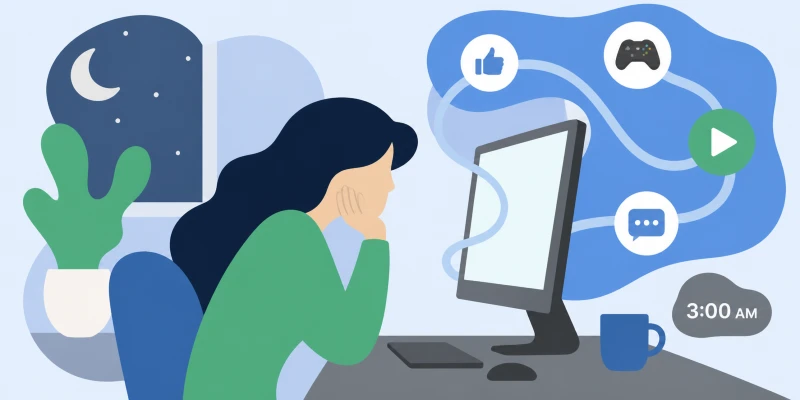
Internet addiction affects an estimated 1 in 5 internet users worldwide (SQ Magazine). Recent data from the same source and other research paint a clear picture of the scale.
- 21.8% of internet users worldwide show signs of moderate to severe problematic screen time in 2025. That is roughly 1 in 5 people online.
- North America sits at 15.2%, with rates steadily rising over the past five years. Western Europe has the lowest rate at 8.7%.
- Teens (13-17) face the highest risk with some estimates suggesting over 70% show signs of problematic internet use.
- Average screen time for US adults reached 7.6 hours per day in 2025, with social media consuming nearly 3 hours of that.
- 32% of US teens report feeling anxious when they are not connected to the internet.
- 57% of people seeking help for problematic screen time also report symptoms of anxiety or depression.
- Smartphone use drives 71% of reported digital overuse cases, with app-based services designed for maximum engagement.
- Asia and the Middle East report the highest rates globally, with double-digit prevalence among youth in China, South Korea, and Taiwan.
In Canada, screen time data from the Canadian Community Health Survey shows that a growing number of Canadians report spending 15 or more hours per week online for non-work purposes, with young adults consistently logging the most time. The Canadian Internet Use Survey found that nearly all Canadians aged 15-34 use the internet daily, and social media use continues to rise across all age groups. Canada has also been at the forefront of research into problematic internet use through organizations like the Canadian Centre on Substance Use and Addiction (CCSA), which has examined the links between excessive screen time and mental health outcomes.
If you're wondering about your internet use, you are not alone. Many people wrestle with the same question. Problematic use is not about how much time you spend online. It is about control and consequences.
Signs that technology use may be problematic, based on common criteria for behavioral addictions (ICD-11):
- You spend more time online than you intend to, regularly
- You have tried to cut back on screen time and failed
- You feel anxious, irritable, or restless when you cannot get online
- You reach for your phone automatically, even during conversations or activities
- Your sleep, work, or relationships have suffered because of screen time
- You find yourself scrolling without really paying attention (mindless use)
- You hide or downplay how much time you spend on devices
If several of these feel familiar, your internet use may have moved from habit to compulsion. Our Internet Addiction Check can give you a clearer picture.
Internet addiction manifests differently from substance addictions because the behavior itself is normalized and often required for work and social life. But when use becomes compulsive, specific patterns emerge (Frontiers in Psychology).
Behavioral signs:
- Checking devices constantly, even when no notification is present
- Spending increasing amounts of time online to feel satisfied
- Neglecting work, school, or household responsibilities
- Choosing screen time over social activities or hobbies
- Using the internet to escape negative emotions or stress
Physical signs:
- Eye strain, headaches, or blurred vision from extended screen use
- Poor posture and neck or back pain ("tech neck")
- Sleep disruption from late-night screen use
- Reduced physical activity and exercise
Emotional signs:
- Irritability or mood swings when unable to access devices
- Anxiety about missing out (FOMO) when offline
- Feelings of guilt or shame about screen time
- Using screens to manage difficult emotions rather than addressing them
This is a debated topic, but the evidence increasingly supports that excessive screen time can produce addiction-like changes in the brain. While not yet a standalone DSM-5 diagnosis, internet gaming disorder is included as a condition for further study, and the WHO recognized gaming disorder in the ICD-11.
Dopamine and variable rewards. Every time you check your phone, there is a chance you will see something rewarding: a like, a message, a notification. This is called variable ratio reinforcement, the same mechanism that makes slot machines addictive. Your brain releases a small pulse of dopamine each time, training you to check again and again (Mindlab Neuroscience).
Brain changes. Neuroimaging studies have found that excessive internet use is associated with structural and functional changes in the brain, including reduced gray matter in regions involved in impulse control and decision making.
Designed for engagement. Unlike substance addiction where a chemical hijacks the brain's reward system, excessive screen time exploits the brain's natural reward system through careful design. Apps and platforms are optimized to maximize time spent, often at the expense of user wellbeing.
This is a crucial distinction. Many people spend a lot of time online without it being a problem. The difference lies in control, compulsion, and negative consequences (Mindlab Neuroscience).
Heavy but healthy use often looks like:
- You spend significant time online but can stop when needed
- Screen time is purposeful (work, learning, connecting with people)
- No negative impact on sleep, relationships, or responsibilities
- You do not feel anxious or distressed when offline
- You have other hobbies and interests beyond screens
Problematic use often looks like:
- You try to limit screen time but find yourself back within minutes
- You scroll mindlessly for longer than you want to
- Your sleep, productivity, or relationships are suffering
- You feel anxious, bored, or irritable without your devices
- You use screens to avoid difficult emotions or situations
The key test: if you set a timer for 15 minutes of scrolling, can you stop when the timer goes off? If the answer is regularly no, that is a sign of lost control.
Excessive screen time rewires the brain in ways that are increasingly measurable. The mechanisms mirror those seen in behavioral addictions like gambling (Frontiers in Psychology).
Dopamine dysregulation. Every notification, like, or new piece of content triggers a small dopamine release. Over time, the brain becomes less sensitive to dopamine, requiring more stimulation to feel the same reward. This drives the cycle of compulsive checking.
Attention fragmentation. Constant switching between apps, tabs, and notifications trains the brain for short attention spans. The average person checks their phone 96 times per day. Each interruption takes over 20 minutes to fully refocus on the original task. Over time, this can reduce the ability to sustain deep focus.
Sleep disruption. Blue light from screens suppresses melatonin production, delaying sleep onset and reducing sleep quality. Late-night screen use is linked to increased insomnia, especially among teenagers and young adults.
Prefrontal cortex changes. The prefrontal cortex, responsible for impulse control and decision making, can be affected by chronic screen overuse. This makes it harder to resist the urge to check devices, creating a self-reinforcing cycle.
The encouraging news: these changes are reversible. Reducing screen time and practicing digital mindfulness can help the brain recover its natural attention and reward balance.
The relationship between social media and mental health is complex and well studied (Mindlab Neuroscience).
Social comparison. Social media platforms present curated versions of other people's lives. Constant exposure can lead to unfavorable comparisons, feelings of inadequacy, and lower self esteem. This effect is strongest among teenagers and young adults.
FOMO and anxiety. Fear of missing out drives compulsive checking. The anxiety that others are having rewarding experiences without you keeps you scrolling. Paradoxically, the more you check, the more anxious you can feel.
Doomscrolling. The tendency to continue consuming negative news online, even when it is distressing, is a recognized pattern. Negative content captures attention more effectively, and algorithms learn to serve more of it.
Sleep and mood. Late-night social media use affects both sleep quality and next-day mood. The combination of blue light exposure and emotional content before bed creates a poor foundation for restorative sleep.
Not all social media use is harmful. Purposeful use that involves genuine connection, learning, or creative expression is different from passive, compulsive scrolling. The key is awareness of how it makes you feel.
Yes, and this is one of the most commonly reported effects of technology overuse (SQ Magazine). The constant stream of notifications, alerts, and new content trains the brain for short, fragmented attention rather than sustained focus.
Task switching costs. Every time you switch between tasks, your brain requires cognitive effort to reorient. The average office worker switches tasks every 3 minutes when notifications are enabled. The cumulative cost of these switches can reduce productivity by up to 40%.
Attention residue. When you partially check a notification and return to your original task, part of your attention remains on the interruption. This attention residue reduces the quality of your focus on the primary task.
Training for distraction. Over time, the brain learns that rewards come from the next piece of content, not from sustained work on challenging tasks. This can make focused work feel uncomfortable or unrewarding, even when no device is present.
The solution is not to eliminate technology but to create intentional boundaries: scheduled focus time, notification-free periods, and device-free spaces in your day.
When heavy technology users try to cut back, many experience withdrawal-like symptoms (NIH). These are not dangerous, but they can be uncomfortable and are a major reason why people return to old habits.
Common experiences during a digital detox:
- Anxiety and restlessness: Feeling uneasy or on edge without your devices
- Cravings to check: Strong urges to pick up your phone, often triggered by old habits (waking up, waiting, boredom)
- FOMO (fear of missing out): Worrying that something important is happening online without you
- Irritability: Feeling short-tempered or frustrated, especially in the first few days
- Boredom: Discovering that you have more unstructured time than you are used to
- Phantom vibrations: Feeling your phone buzz when it hasn't, a sign that your brain has been conditioned to expect notifications
These symptoms typically peak in the first 3-5 days and gradually ease as your brain adjusts to lower stimulation levels. Most people report feeling more focused, calm, and present after one to two weeks of reduced use.
The timeline for resetting your relationship with technology varies, but a general pattern has been reported by many people who have done digital detoxes. A 2025 scoping review found that digital detox interventions can lead to measurable improvements in mental health and wellbeing (NIH).
Days 1-3: The hardest period. Cravings to check devices are frequent and intense. Boredom may feel uncomfortable. You may reach for your phone automatically many times before remembering. Withdrawal symptoms peak.
Days 4-7: Cravings begin to decrease in frequency. You start to notice the world around you more. Time may feel slower at first, then fuller. Sleep often improves.
Weeks 2-4: The urge to check becomes less automatic. Focus improves. Conversations feel deeper. You may discover or rediscover hobbies that do not involve screens.
Longer term: The brain's reward system recalibrates. Activities that felt boring become more engaging. The constant urge to fill every moment with stimulation fades. Many people report feeling more present and less anxious.
Even a 24-hour digital detox can provide meaningful insight into your relationship with technology. You may be surprised by what you notice when you are not looking at a screen.
Yes. And for many people, sleep changes are the first noticeable improvement after cutting back. But initially, the withdrawal itself can temporarily disrupt sleep patterns.
Why it helps: Blue light from screens suppresses melatonin production. Late-night scrolling keeps your brain alert when it should be winding down. Reducing screen time, especially in the hour before bed, allows your natural sleep cycle to reset. Many people report falling asleep faster and waking up feeling more rested within just a few days of cutting back.
The withdrawal twist: In the first few nights of reduced screen time, you may actually find it harder to sleep. This is because your brain has become conditioned to the stimulation of scrolling as a pre-sleep ritual. Boredom and racing thoughts can fill the gap. This phase usually passes within 3-5 nights as your brain adapts to a calmer wind-down routine (NIH).
Replacing late-night scrolling with reading, gentle stretching, or even just lying quietly can speed up this transition significantly.
Phantom vibration syndrome, feeling your phone buzz when it hasn't, is surprisingly common and affects the majority of smartphone users at some point. It doesn't necessarily mean you're addicted, but it is a sign that your brain has been conditioned to expect notifications.
What's happening: Your brain has learned to associate certain sensations with phone notifications. When your brain detects a sensation that could be a vibration (muscle twitch, clothing brushing against your leg), it interprets it as a phone buzz. This is called classical conditioning, the same mechanism Pavlov demonstrated with his dogs.
What it means for your habits: Phantom vibrations are more common among people who check their phones frequently and have a strong emotional attachment to their devices. If you experience them regularly, it's a good indicator that your brain has been wired to prioritize your phone. Noticing phantom vibrations is a useful cue to reflect on whether your device use is driven by genuine need or conditioned habit.
The good news: phantom vibrations usually fade within a few days of reducing screen time, as your brain relearns to ignore those false signals.
Reducing screen time does not mean abandoning technology. It means creating a healthier relationship with it. Studies show that even brief digital detox interventions can improve wellbeing (NIH). Here is a practical approach:
1. Track your use. Before you can change it, you need to know it. Use your phone's screen time tracker for a few days. The number is often higher than you expect.
2. Remove friction from good habits, add friction to bad ones. Keep your phone in another room while working. Turn off all non-essential notifications. Use grayscale mode to make the screen less visually stimulating. Delete apps that you mindlessly open.
3. Schedule device-free time. Start with one hour before bed and one hour after waking. No phone in the bedroom. These two blocks alone can significantly reduce total screen time and improve sleep.
4. Create replacement activities. The brain needs something to fill the gap. Reading physical books, exercise, time in nature, creative hobbies, and in-person social activities all provide healthy stimulation without screens.
5. Use the 20-20-20 rule. Every 20 minutes, look at something 20 feet away for 20 seconds. This reduces eye strain and builds awareness of how long you have been on a device.
6. Set intentional use rules. No phones at the dinner table. No screens in the bedroom. No scrolling while watching TV (it fragments attention for both). Pick two rules and stick with them for 30 days.
7. Try the 90-Second Urge Reset: When you feel the automatic urge to check your phone, pause for 90 seconds before acting. This brief gap is often enough for the impulse to pass.
Start by taking our Internet Addiction Check to understand where you stand.
Reducing screen time triggers a series of positive changes that unfold over days and weeks (NIH). Many people are surprised by how quickly they notice a difference.
Week 1: The hardest phase. Withdrawal symptoms peak. You may feel bored, restless, or anxious without your usual digital stimulation. This is normal and temporary.
Weeks 2-3: Sleep improves as blue light exposure decreases. You may find yourself reading more, spending more time outdoors, or having longer conversations. Focus during work hours often improves noticeably.
Month 1+: The automatic urge to check devices decreases significantly. You feel more present in daily activities. Your attention span for long-form content (books, movies, conversations) improves. Many people report feeling calmer and less anxious.
What people report after reducing screen time:
- Better sleep quality and more consistent sleep schedules
- Improved focus and productivity
- Deeper conversations and stronger relationships
- More time for hobbies, exercise, and rest
- Reduced anxiety and less social comparison
- Greater satisfaction with real-life experiences
- A sense of reclaiming control over time and attention
The urge to check your phone has been trained into you through thousands of repetitions. It is not a moral failing. It is a conditioned response that can be unlearned with time and practice (Mindlab Neuroscience).
Recognize the pattern. Most phone checking follows a trigger-response cycle: a feeling of boredom, a moment of waiting, a notification sound, or simply seeing your phone on the table. Recognizing the trigger is the first step to breaking the cycle.
Create a delay. When the urge to check hits, commit to waiting 60 seconds before reaching for your device. In that time, ask yourself: do I actually need to check this right now? Often the urge passes.
Replace the automatic behavior. Instead of checking your phone during micro-moments (waiting in line, at a red light, during a commercial break), try looking around, taking a breath, or noticing your surroundings. These micro-breaks are surprisingly refreshing once you get used to them.
Change your environment. Your phone's presence alone reduces cognitive capacity, even when it is face down and on silent. Keep it in a different room during focused work. Use a physical alarm clock instead of your phone. Create phone-free zones in your home.
Use the 90-Second Urge Reset: A quick anchor technique to ride out the automatic urge without giving in.