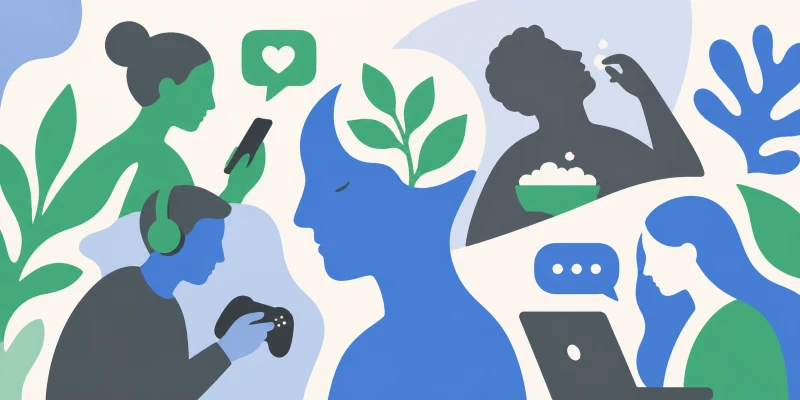
What Is Behavioral Addiction?
Behavioral addiction, sometimes called process addiction or non-substance addiction, is a pattern of compulsive behavior that continues despite harmful consequences to health, relationships, work, or finances.
Unlike substance addictions involving drugs or alcohol, behavioral addictions center on activities that are normally rewarding or even necessary. Eating, shopping, using the internet. But these behaviors have spiraled beyond the person's control.
The key distinction: it's not about what you're doing.
It's about your relationship with it.
Plenty of people gamble occasionally, play video games, or browse social media without issue.
Behavioral addiction happens when the activity becomes compulsive, persists despite negative consequences, and the person feels unable to stop or cut back.
In 2013, the American Psychiatric Association recognized gambling disorder as the first behavioral addiction in the DSM-5, the diagnostic manual used by mental health professionals worldwide.
Internet gaming disorder was included as a condition warranting further study.
This signaled growing recognition that the brain can become addicted to behaviors just as it can to chemicals.
Frequently Asked Questions
Yes. Neuroimaging studies show that behavioral addictions activate the same brain regions, involve the same neurotransmitter systems (particularly dopamine), and produce the same patterns of tolerance, withdrawal, and loss of control as substance addictions.
A gambling addict's brain scan looks remarkably similar to a cocaine user's brain scan when exposed to their respective triggers.
The addiction is real. The substance is just different.
Absolutely. Having one behavioral addiction significantly increases the risk of developing another.
This is partially because the underlying mechanism, using external stimulation to regulate internal emotional states, is shared across behaviors. Someone recovering from gambling addiction might find themselves compulsively shopping or gaming as a replacement.
This pattern is called addiction transfer or cross-addiction, and it's one reason comprehensive treatment addresses root patterns, not just the specific behavior.
Treatment approaches largely mirror those used for substance use disorders.
Cognitive Behavioral Therapy (CBT) is the most researched and widely recommended treatment. It helps identify and change the thought patterns and triggers that drive compulsive behavior, building practical coping strategies.
Support groups including Gamblers Anonymous, Internet and Technology Addicts Anonymous (ITAA), and Debtors Anonymous provide peer support, accountability, and structured recovery programs based on 12-step principles.
Medication may be prescribed when behavioral addiction co-occurs with depression, anxiety, or ADHD, treating underlying conditions that contribute to the addictive pattern.
A bad habit is something you do automatically but can stop with effort and commitment. A behavioral addiction involves compulsion, a sense that you've lost the ability to choose.
Key differences: habits don't typically escalate, you don't need to bite your nails more aggressively over time. Addictions tend to intensify.
Stopping a habit causes mild discomfort. Stopping an addiction causes significant distress or withdrawal-like symptoms.
A habit might be annoying. An addiction causes measurable harm to finances, relationships, health, or daily functioning.
Taking the First Step
Recognizing that a behavior might be problematic is itself a significant step. Many people spend years rationalizing, minimizing, or simply not seeing the pattern. The fact that you're reading this suggests a level of self-awareness worth acknowledging.
The behavior addiction checks above provide a structured starting point for reflection. They're not diagnostic tools. No online check replaces a professional evaluation. But they can help you organize your thoughts, identify patterns, and decide whether it's worth exploring further with a therapist, counselor, or support group.
Recovery from behavioral addiction is possible. The brain's neuroplasticity means new, healthier patterns can be built over time. Each small choice to respond differently to a trigger strengthens those new pathways.
It's not about being perfect. It's about progress.
See a problem on this page? Tell us