Benzodiazepine Addiction Q&A
Benzodiazepines, often called benzos, are among the most commonly prescribed medications in the world, and they are also among the most commonly misused. Below, we answer the most common questions about benzos use: the warning signs of dependence, how quickly it can develop, why withdrawal can be dangerous, and what actually helps when you want to stop safely. When you're ready, take our free Benzodiazepine Addiction Check (Takes 1-3 minutes, confidential, with instant results)
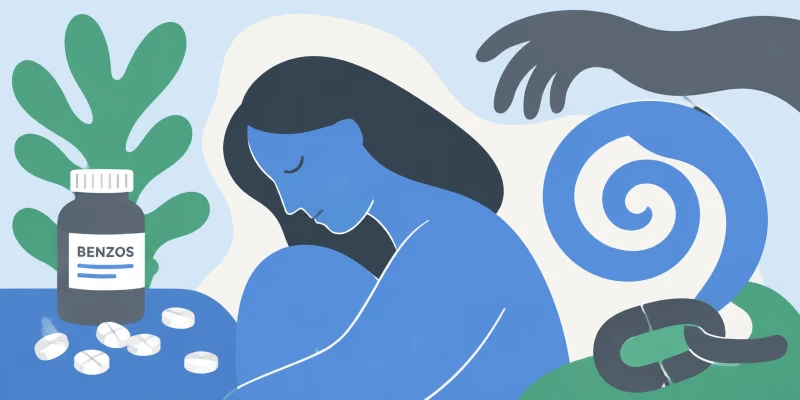
Benzodiazepines are among the most commonly prescribed medications in the world, and their misuse is a significant public health concern. Most statistics below come from NIDA and the CDC.
- Overdose deaths involving benzodiazepines reached roughly 10,870 in 2023, according to NIDA data, with nearly 70% of those deaths also involving illicitly manufactured fentanyl.
- Opioids are involved in about 75% of deaths involving benzodiazepines. Both drug classes suppress breathing, which is the cause of fatal overdose.
- Benzodiazepines are widely prescribed for anxiety, insomnia, and other conditions, meaning many people who develop dependence began with a legitimate prescription.
- No FDA-approved medication exists to treat benzodiazepine withdrawal itself. The standard approach is a gradual, medically supervised taper.
- Misuse is common among older adults and among people who combine benzodiazepines with other substances.
Benzodiazepine dependence can develop even when the medication is taken exactly as prescribed, which makes it unique among commonly misused drugs. This is why the distinction between prescribed use and dependence is so important.
If you are asking this question, you have likely noticed some patterns that concern you. With benzodiazepines, the picture involves both physical dependence and behavioral signs.
Signs that point toward benzodiazepine dependence:
- You take a higher dose than prescribed
- You run out of your prescription early
- You have tried to cut back or stop and could not
- You experience withdrawal symptoms when you miss a dose
- You need more of the medication to get the same effect (tolerance)
- You continue using despite negative effects on your memory, relationships, or responsibilities
- You have sought the medication from multiple sources or without a prescription
- You combine it with alcohol, opioids, or other drugs
If several of these ring true, you may be experiencing benzodiazepine dependence. Our Benzodiazepine Use Check can give you a clearer picture.
Benzodiazepine dependence shows up in physical, behavioral, and psychological signs. Some are subtle and easy to dismiss as the underlying condition returning.
Physical signs:
- Drowsiness, sluggishness, and slowed coordination
- Memory problems and difficulty concentrating
- Slurred speech or confusion at higher doses
- Tremors, sweating, or anxiety when a dose is missed
- Sleep disturbances, especially rebound insomnia
Behavioral signs:
- Taking more than prescribed or running out early
- Seeking the medication from multiple doctors or sources
- Planning your schedule around when you can take the next dose
- Combining with alcohol or other substances to boost the effect
- Hiding or lying about your use
Psychological signs:
- Feeling unable to function without the medication
- Anxiety that spikes when a dose is missed
- Cravings and preoccupation with the next dose
- Emotional numbness or detachment
Benzodiazepine dependence can develop faster than many people expect, and it can happen even when the medication is taken exactly as prescribed. This is what makes benzodiazepines different from many other drugs.
Short-term use: For most people, taking a benzodiazepine for a few days to a couple of weeks is unlikely to cause significant dependence. This is why they are often prescribed for short-term relief of acute anxiety or insomnia.
Weeks to months: Physical dependence can begin to develop within a few weeks of regular daily use. The body adapts to the presence of the drug, and stopping suddenly can trigger withdrawal symptoms.
Long-term use: People who take benzodiazepines daily for months or years are at the highest risk of dependence. At this stage, stopping without a gradual taper can produce severe withdrawal symptoms, including seizures in some cases.
The dose matters: Higher doses and longer durations both increase the risk. Short-acting benzodiazepines like Xanax (alprazolam) can also produce sharper withdrawal than long-acting ones like Valium (diazepam).
With benzodiazepines, the distinction between physical dependence and addiction is especially important, because they are not the same thing.
Physical dependence: This means your body has adapted to the drug and needs it to function normally. If you stop suddenly, you experience withdrawal. Dependence can happen to anyone who takes benzodiazepines regularly, even exactly as a doctor prescribed, and it is not a sign of moral failure.
Addiction: This involves compulsive use despite negative consequences. It includes behaviors like taking more than prescribed, running out early, seeking the drug from multiple sources, and continuing use despite harm to relationships, work, or health.
The two often overlap, but a person can be physically dependent without being addicted, and the treatment approach matters for both. Physical dependence requires a careful taper. Addiction may require additional behavioral treatment.
Benzodiazepines are central nervous system depressants, meaning they slow down brain activity. They work by enhancing the effect of a neurotransmitter called GABA, which has a calming, inhibitory effect throughout the nervous system.
Brain effects: By boosting GABA, benzodiazepines reduce anxiety, relax muscles, and promote sleep. With regular use, the brain adapts by becoming less sensitive to its own GABA. This is why stopping suddenly can leave the brain in a state of overactivity, producing anxiety, agitation, and in severe cases seizures.
Cognitive effects: Benzodiazepines impair short-term memory and slow thinking. With long-term use, these cognitive effects can persist and may resemble the early stages of dementia in some older adults.
Sedation and coordination: Benzodiazepines cause drowsiness and impair coordination, which is why they carry warnings about driving and operating machinery. These effects are sharply increased when combined with alcohol or opioids.
Breathing suppression: At high doses, and especially in combination with other depressants, benzodiazepines can suppress breathing. This is the mechanism behind most fatal benzodiazepine overdoses.
Benzodiazepines are often prescribed for mental health conditions like anxiety and insomnia, but their long-term relationship with mental health is complicated.
Short term relief: Benzodiazepines can quickly reduce anxiety and help with sleep, which is why they are effective for acute distress.
Rebound anxiety: When the medication wears off or is stopped, anxiety can return more intensely than before. This rebound effect can make it feel like the medication is necessary when it is actually part of the problem.
Emotional blunting: Long-term use can dull emotions and motivation, leaving people feeling flat or detached. This can resemble depression and make it harder to engage with life.
Dependence and the anxiety cycle: Over time, the brain's reduced sensitivity to its own GABA can make baseline anxiety worse, creating a cycle where the medication that once helped is now needed just to feel normal.
This is one of the most important safety facts about benzodiazepines. Combining them with opioids or alcohol is extremely dangerous because all three suppress the central nervous system and slow breathing.
The mechanism: Benzodiazepines, opioids, and alcohol each depress breathing. When combined, their effects multiply rather than add. The result can be respiratory depression severe enough to cause coma or death.
The numbers: According to NIDA, opioids are involved in about 75% of deaths involving benzodiazepines. Nearly 70% of benzodiazepine overdose deaths also involve illicitly manufactured fentanyl.
What this means: Even a dose that would be safe on its own can be fatal when combined. Many people who die from this combination did not intend to overdose. They simply combined medications without understanding the risk.
If you take benzodiazepines, be honest with your prescriber about any other medications, alcohol, or substances you use. This is not about judgment. It is about safety.
Benzodiazepine withdrawal is different from most other drug withdrawals in one critical way: it can be life-threatening. Most drug withdrawals are extremely uncomfortable but rarely fatal. Benzodiazepine withdrawal, like alcohol withdrawal, can cause seizures and other severe complications.
The reason: Benzodiazepines enhance the brain's main calming chemical, GABA. With regular use, the brain becomes dependent on the drug to stay calm. Removing it suddenly can leave the brain in a state of dangerous overactivity, which can trigger grand mal seizures.
Who is at risk: The risk is highest for people who have taken benzodiazepines daily for a long time or at high doses. But the risk is real for anyone with physical dependence, which is why stopping suddenly is never recommended.
The solution: The safe approach is a gradual, medically supervised taper, where the dose is reduced slowly over weeks or months under a doctor's guidance. This gives the brain time to adapt. For heavy or long-term users, a medical detox program provides the safest environment.
The key message: If you take benzodiazepines regularly, do not stop suddenly. Seek medical guidance for a safe taper.
Benzodiazepine withdrawal can produce a wide range of symptoms, from mild discomfort to severe and dangerous complications. The severity depends on how long and how much a person has been taking.
Common withdrawal symptoms include:
- Rebound anxiety: Anxiety that returns more intensely than before
- Insomnia: Difficulty falling or staying asleep
- Irritability and agitation: Feeling on edge or restless
- Tremors and sweating: Physical signs of nervous system overactivity
- Palpitations: A racing or pounding heart
- Muscle tension and pain: Aches throughout the body
- Nausea: Stomach discomfort
- Seizures: In severe cases, withdrawal can trigger grand mal seizures
Because the symptom list can include seizures, benzodiazepine withdrawal should always be managed with medical supervision rather than attempted cold turkey.
The benzodiazepine withdrawal timeline depends heavily on the specific medication, particularly its half-life. Short-acting and long-acting benzodiazepines produce different patterns.
Short-acting (Xanax, Ativan): Withdrawal can begin within 6-12 hours of the last dose and peak within a few days. Symptoms tend to be sharp and intense because the drug clears the body quickly.
Long-acting (Valium, Klonopin): Withdrawal begins later, often within 1-4 days, and symptoms may be more gradual because the drug leaves the body slowly, providing a partial self-taper.
General timeline:
- Days 1-4: Rebound anxiety, insomnia, and agitation begin
- Days 4-14: Symptoms peak for short-acting benzos; this is the highest-risk window for seizures
- Weeks 2-4: Acute symptoms gradually ease
- Weeks to months: Some people experience a protracted withdrawal with lingering anxiety, insomnia, and mood changes that improve gradually
The safest and most comfortable approach is a gradual taper, which stretches this timeline out but avoids the dangerous peaks.
Yes. This is the single most important thing to understand about benzodiazepines. Unlike withdrawal from most other substances, benzodiazepine withdrawal can be life-threatening.
The main risk is seizures. Stopping benzodiazepines suddenly after a period of regular use can trigger grand mal seizures, which in severe cases can progress to coma or death. This risk is shared with alcohol withdrawal, another of the few drug withdrawals that can be fatal.
Who is most at risk: People who have taken benzodiazepines daily for a long time, at high doses, or who have a history of seizures are at the highest risk. But the risk applies to anyone with physical dependence.
How to stay safe: Never stop benzodiazepines suddenly. Work with a doctor to taper the dose gradually over weeks or months. For heavy or long-term users, a medically supervised detox provides the safest setting.
When to seek immediate help: If you or someone you know experiences a seizure, severe confusion, hallucinations, or difficulty breathing during benzodiazepine withdrawal, seek emergency medical care immediately.
Tapering is the safe, proven way to stop benzodiazepines. The goal is to reduce the dose gradually so the brain has time to adapt, avoiding the dangerous peaks of cold-turkey withdrawal.
1. Work with a doctor. A benzodiazepine taper should be planned and supervised by a medical professional. Never stop suddenly or design your own rapid taper if you have been taking the medication regularly.
2. Reduce gradually. A typical taper reduces the dose slowly over weeks to months, often in small steps. The exact schedule depends on the medication, the dose, and how long you have been taking it.
3. Consider switching to a long-acting benzodiazepine. Doctors sometimes switch patients from a short-acting benzodiazepine like Xanax to a long-acting one like Valium, which leaves the body more slowly and makes the taper smoother.
4. Add behavioral support. Cognitive behavioral therapy can help manage the underlying anxiety or insomnia that led to the prescription in the first place, reducing the risk of relapse after tapering.
5. Consider medical detox for heavy use. For long-term or high-dose users, an inpatient medical detox provides round-the-clock monitoring and a safe, structured taper.
Recovery from benzodiazepine dependence is possible, but it is a process that takes time. Rushing it is both uncomfortable and dangerous, so patience and professional guidance are essential.
Stopping benzodiazepines safely, through a gradual taper, triggers a recovery process that unfolds over weeks and months. The brain gradually rebuilds its natural GABA balance.
Physical recovery: Sleep patterns normalize. Tremors, sweating, and physical anxiety symptoms fade. Energy and coordination improve.
Cognitive recovery: Memory and concentration improve as the sedating effects wear off. For long-term users, some cognitive fog may persist for months before fully clearing.
Emotional recovery: As the brain recalibrates, anxiety returns to its natural baseline rather than the rebound intensity of withdrawal. Many people report feeling more present and emotionally connected.
What people report after quitting:
- Clearer thinking and better memory
- More stable mood and natural energy
- No longer planning life around the next dose
- Improved relationships and work performance
- Freedom from the anxiety rebound cycle
Benzodiazepine cravings often feel like anxiety or restlessness rather than an obvious desire for a pill. Recognizing them for what they are is the first step to managing them.
Cravings often masquerade as symptoms. What feels like "I need my medication for this anxiety" is often the brain's learned response to a trigger. Naming it as a craving rather than a medical need helps reduce its power.
Practice grounding techniques. Deep breathing, progressive muscle relaxation, and mindfulness can calm the nervous system naturally, addressing the physical sensations behind the craving.
Move your body. Gentle exercise is a natural anti-anxiety tool. A walk, stretching, or any physical activity can help discharge nervous energy and reduce the urge.
Change your environment. Cravings are often tied to context, like the time of day you usually took a dose or a stressful situation. Removing yourself from the trigger can break the cycle.
Reach out before you use. Contacting a supportive person, a sponsor, or a helpline when a craving hits is one of the most effective immediate strategies. Speaking the feeling out loud reduces its intensity.
Remember the cycle. Taking a dose to escape a craving provides temporary relief but strengthens the pattern. Each craving you ride out weakens the neural pathway and brings you closer to recovery.
If you want to stop benzodiazepines or are worried about your dependence, help is available. Because withdrawal can be serious, professional guidance is especially important.
Places to get help:
- Your doctor or prescriber: The most important first step is to talk to the professional who prescribed the medication. A supervised taper is the safest way to stop.
- SAMHSA National Helpline: Free, confidential, 24/7 treatment referral and support. Call 1-800-662-HELP (4357) or visit samhsa.gov.
- Benzodiazepine Information Coalition: Evidence-based information on dependence, withdrawal, and safe tapering. benzoinfo.com
- FindTreatment.gov: A searchable directory of treatment facilities, including medical detox programs.
- SMART Recovery: A science-based mutual support program with free tools and meetings. smartrecovery.org