Social Media Addiction Q&A
Social media is now a constant background presence in daily life. Below, we answer the most common questions about social media addiction: the warning signs, the statistics, how it affects your mood, focus, and relationships, and what actually helps when you want to cut back. When you're ready, take our free Social Media Addiction Check (Takes 1-3 minutes, confidential, with instant results)
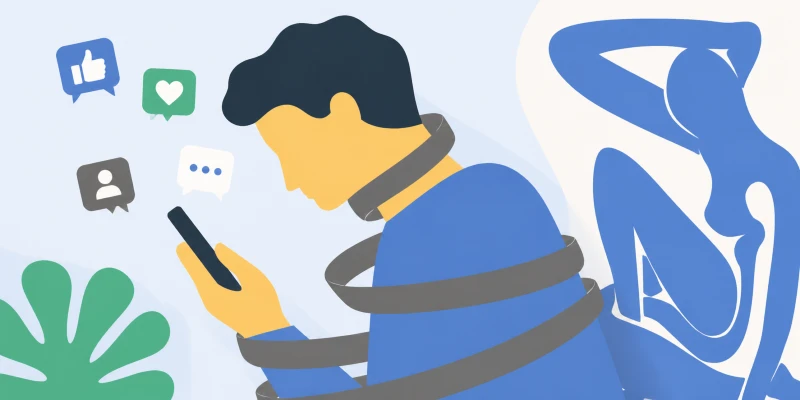
Social media addiction is one of the fastest growing behavioral health concerns worldwide. With billions of people on social platforms, the numbers are striking.
- Around 210 million people worldwide are estimated to experience addiction to social media and internet use, roughly 4.7% of all social media users.
- 5-10% of adolescents meet criteria for problematic social media use, and the figure rises to 20-30% among those already dealing with anxiety or depression.
- 82% of Gen Z adults acknowledge feeling dependent on platforms like Instagram, TikTok, and X.
- 36% of teenagers report excessive social media use.
- Teenagers who use social media for 3+ hours a day are at significantly higher risk of depression and anxiety.
The pattern is clear: social media use is climbing, and for a significant portion of users it has crossed from habit into compulsion.
If you are wondering about your social media use, you are not alone. Problematic use is not about how many hours you spend scrolling. It is about control and consequences.
Signs that social media use may be problematic, adapted from behavioral addiction criteria:
- You spend more time on social media than you intend to, regularly
- You have tried to cut back and failed
- You feel anxious, irritable, or restless when you cannot check your feeds
- You think about social media or plan posts when you are offline
- Your sleep, work, or relationships have suffered because of scrolling
- You reach for the app automatically, without thinking
- You feel worse, envious, or inadequate after scrolling, yet keep returning
- You hide or downplay how much time you spend on social media
If several of these feel familiar, your social media use may have moved from habit to compulsion.
Social media addiction manifests differently from substance addictions because the behavior is normalized and often expected. But when use becomes compulsive, specific patterns emerge.
Behavioral signs:
- Checking your feeds constantly, even when no notification is present
- Spending increasing amounts of time to feel the same level of satisfaction (tolerance)
- Neglecting school, work, or household responsibilities
- Choosing scrolling over social activities or hobbies
- Using social media to escape negative emotions or boredom
Emotional signs:
- Irritability or mood swings when unable to check your feeds
- Anxiety about missing out (FOMO) when offline
- Feelings of guilt or shame about your scrolling time
- Social comparison that leaves you feeling inadequate
Physical signs:
- Eye strain and headaches from extended screen time
- Sleep disruption from late-night scrolling
- Reduced physical activity and exercise
The evidence increasingly supports that excessive social media use can produce addiction-like changes in the brain. While not yet a standalone DSM-5 diagnosis, the mechanisms are well documented.
Dopamine and variable rewards. Every time you open your feed, there is a chance you will see something rewarding: a like, a comment, a funny video. This is called variable ratio reinforcement, the same mechanism that makes slot machines so addictive. Your brain releases a small pulse of dopamine each time, training you to check again and again.
Brain changes. Research shows that extended social media exposure alters dopamine regulation in ways that closely mirror substance addiction. The reward system becomes conditioned to expect stimulation from the next post.
Designed for engagement. Unlike substance addiction where a chemical hijacks the brain, social media exploits your natural reward system through careful design. Infinite scroll, pull to refresh, and personalized algorithms are all optimized to maximize time spent, often at the expense of wellbeing. For a deeper look at the psychology behind this, read our post Why You Can't Put Your Phone Down.
This is a crucial distinction. Many people spend a lot of time on social media without it being a problem. The difference lies in control, compulsion, and negative consequences.
Heavy but healthy use often looks like:
- You spend time on social media but can stop when needed
- Your use is purposeful (connecting, creating, learning)
- No negative impact on sleep, relationships, or responsibilities
- You do not feel anxious or distressed when offline
- You have other hobbies and interests beyond your feed
Problematic use often looks like:
- You try to limit your time but find yourself back within minutes
- You scroll mindlessly for longer than you want to
- Your sleep, productivity, or relationships are suffering
- You feel anxious, bored, or irritable when you cannot check your feeds
- You use social media to avoid difficult emotions or situations
The key test: if you set a timer for 10 minutes of scrolling, can you stop when the timer goes off? If the answer is regularly no, that is a sign of lost control.
Teenagers are the most vulnerable group when it comes to social media addiction, and the numbers tell a concerning story. Between 5% and 10% of adolescents meet criteria for problematic social media use, and some studies suggest the figure could be significantly higher.
Why teenagers are at higher risk:
- Brain development. The teenage brain is still developing impulse control and decision making. The reward centers are highly active, while the prefrontal cortex, which helps with self-regulation, is still maturing. This makes teens especially susceptible to the dopamine-driven feedback loops of social media.
- Social pressure. Social media creates constant comparison with curated versions of peers' lives. This effect is strongest during adolescence, when fitting in and social acceptance are paramount.
- Sleep vulnerability. Teenagers already have shifted sleep cycles due to puberty. Late-night scrolling compounds this, leading to chronic sleep deprivation that affects mood, grades, and mental health.
- Fear of missing out (FOMO). The anxiety that something important is happening online without them drives compulsive checking and makes it very hard to disconnect.
The research is sobering:
- Teenagers who use social media for three or more hours a day are at increased risk of depression and anxiety.
- A systematic review found that social networking site use is associated with an increased risk of depression, anxiety, and psychological distress (Keles et al., 2020).
- Adolescent girls are particularly vulnerable to self-esteem damage from platforms like Instagram and TikTok, where constant comparison to filtered, curated lives takes a toll.
The good news: these effects are reversible. Reducing social media use, especially before bed, and building awareness can make a real difference in teenage mental health.
If you are a parent concerned about your teenager's social media use, you are not alone. Social media addiction is increasingly recognized as a significant challenge for today's families.
Signs your teen might be struggling:
- Checking social media during the night or first thing on waking
- Becoming irritable or anxious when the phone is taken away
- Declining grades or loss of interest in hobbies they used to enjoy
- Choosing scrolling over family meals or face-to-face interactions
- Hiding screen time or becoming defensive about social media use
- Expressing feelings of inadequacy or comparing themselves to others online
What helps:
- Set boundaries together rather than imposing them. Family agreements about phone-free times work better than bans.
- Model healthy use yourself. Teenagers are far more likely to change their habits when they see adults doing the same.
- No phone in the bedroom overnight. This is the single most effective change. A physical alarm clock replaces the need for a phone.
- Encourage offline activities. Sports, hobbies, and in-person social time give the brain healthy alternatives.
- Talk about the design of apps. Explain how social media is engineered to keep them scrolling. Understanding the mechanics reduces the power they have.
The goal is not to eliminate social media but to build a healthier relationship with it. The teenage years are when digital habits are formed that can last a lifetime.
If you are a teenager reading this, know that you are not broken, lazy, or weak-willed. Social media is designed to be hard to put down, and the struggle is real. Why You Can't Put Your Phone Down explains exactly how the design works and what you can do about it.
Your brain on social media: Every time you get a like, a comment, or even just see something interesting, your brain gets a small hit of dopamine. This is your brain's reward chemical, and it tells you "that felt good, do it again." Over time, your brain needs more stimulation to feel the same reward, so you check more often, and the cycle speeds up.
This is not your fault. The smartest designers and engineers in the world are paid to keep you scrolling. Infinite scroll, personalized algorithms, notification badges, every feature is tested and optimized to capture your attention. You are up against a system fine-tuned over years to be as engaging as possible.
The good news: Your brain can unlearn these patterns. Just a few days of reduced social media use can start to reset your reward system. Things that felt boring before start to feel engaging again. Sleep improves. And you get back a sense of control over your own time and attention.
Excessive social media use rewires the brain in ways that are increasingly measurable. The mechanisms mirror those seen in behavioral addictions like gambling.
Dopamine dysregulation. Every notification, like, or new piece of content triggers a small dopamine release. Over time, the brain becomes less sensitive to dopamine, requiring more stimulation to feel the same reward. This drives the cycle of compulsive checking.
Attention fragmentation. Constant switching between apps and content trains the brain for short, fragmented attention rather than sustained focus. Each interruption takes time to recover from.
Social comparison circuitry. The brain is wired to evaluate social standing. Social media constantly presents curated highlights of others' lives, triggering comparison processes that can lower self-esteem over time.
Sleep disruption. Blue light from screens suppresses melatonin production, and engaging content delays sleep. Late-night scrolling is linked to increased insomnia, especially among teenagers.
The encouraging news: these changes are reversible. Reducing screen time and practicing digital mindfulness can help the brain recover its natural attention and reward balance.
The relationship between social media use and mental health is complex and well studied.
Depression and anxiety. Research consistently finds that high-frequency social media use is associated with higher rates of depression and anxiety. A systematic review by Keles et al. (2020) found that social networking site use is linked to an increased risk of depression, anxiety, and psychological distress.
Social comparison. Social media presents curated versions of other people's lives. Constant exposure can lead to unfavorable comparisons, feelings of inadequacy, and lower self-esteem. This effect is strongest among teenagers and young adults.
FOMO and anxiety. Fear of missing out drives compulsive checking. The anxiety that others are having rewarding experiences without you keeps you scrolling. Paradoxically, the more you check, the more anxious you can feel.
Digital stress. The constant stream of messages, notifications, and social demands is related to perceived stress and has an indirect impact on depression and anxiety.
Not all social media use is harmful. Purposeful use that involves genuine connection, learning, or creative expression is different from passive, compulsive scrolling. The key is awareness of how it makes you feel.
Yes, and this is one of the most commonly reported effects of social media overuse. The constant stream of notifications, alerts, and new content trains the brain for short, fragmented attention rather than sustained focus.
Task switching costs. Every time you switch between a task and your feed, your brain requires cognitive effort to reorient. Each switch costs time and mental energy.
Attention residue. When you partially check a notification and return to what you were doing, part of your attention remains on the interruption. This reduces the quality of your focus on the original task.
Training for distraction. Over time, the brain learns that rewards come from the next piece of content, not from sustained work on challenging tasks. This can make focused work feel uncomfortable or unrewarding.
The solution is not to eliminate social media but to create intentional boundaries: scheduled focus time, notification-free periods, and phone-free spaces in your day.
When heavy social media users try to cut back, many experience withdrawal-like symptoms. These are not dangerous, but they can be uncomfortable and are a major reason why people return to old habits.
Common experiences when reducing social media use:
- Anxiety and restlessness: Feeling uneasy or on edge without your feeds
- Cravings to check: Strong urges to open the app, often triggered by old habits (waking up, waiting, boredom)
- FOMO (fear of missing out): Worrying that something important is happening online without you
- Irritability: Feeling short-tempered or frustrated, especially in the first few days
- Boredom: Discovering that you have more unstructured time than you are used to
These symptoms typically peak in the first 3-5 days and gradually ease as your brain adjusts to lower stimulation levels. Most people report feeling more focused, calm, and present after one to two weeks of reduced use.
Reducing social media time does not mean abandoning it entirely. It means creating a healthier relationship with it. Studies show that even brief digital detox interventions can improve wellbeing. Here is a practical approach:
1. Track your use. Before you can change it, you need to know it. Use your phone's screen time tracker for a few days. The number is often higher than you expect.
2. Turn off all non-essential notifications. Only allow notifications from actual people you care about. Apps can wait.
3. Remove apps from your home screen. Adding friction makes mindless opening less automatic. You can always access them through a browser.
4. No phone in the bedroom. Get a physical alarm clock. This one change alone can dramatically improve sleep and reduce overall screen time.
5. Use grayscale mode. Switching your phone screen to black and white makes it less visually stimulating and reduces the urge to scroll.
6. Schedule phone-free time. Start with one hour before bed and one hour after waking. These two blocks alone can significantly change your relationship with social media.
7. Create replacement activities. The brain needs something to fill the gap. Reading physical books, exercise, time in nature, and in-person social activities all provide healthy stimulation without screens.
8. Use the 90-Second Urge Reset. When you feel the automatic urge to check your feeds, pause for 90 seconds before acting. This brief gap is often enough for the impulse to pass.
The timeline varies, but a general pattern has been reported by many people who have cut back on social media.
Days 1-3: The hardest period. Cravings to check are frequent and intense. Boredom feels uncomfortable. You may reach for the app automatically many times before remembering. Withdrawal symptoms peak.
Days 4-7: Cravings begin to decrease. You start to notice the world around you more. Sleep often improves noticeably.
Weeks 2-4: The urge to check becomes less automatic. Focus improves. Conversations feel deeper. You may rediscover hobbies that do not involve a screen.
Longer term: Your brain's reward system recalibrates. Activities that felt boring become more engaging. The constant urge to fill every moment with stimulation fades.
What people report after reducing social media use:
- Better sleep quality and more consistent sleep schedules
- Improved focus and productivity
- Deeper conversations and stronger relationships
- Reduced anxiety and less social comparison
- Greater satisfaction with real-life experiences
- A sense of reclaiming control over time and attention
Even a 24-hour break can provide meaningful insight into your relationship with social media.
Social media addiction is treatable. Several approaches have been shown to help people regain control over their scrolling.
Cognitive Behavioral Therapy (CBT) is the most research-backed approach. It helps identify triggers, develop coping strategies, and break the automatic checking cycle.
Digital detox programs involve periods of reduced or eliminated social media use, often structured as a 7-30 day program. Even short detoxes provide meaningful insight.
Support groups like Internet and Technology Addicts Anonymous (ITAA) provide community and accountability, with meetings specifically for social media.
Environmental changes such as removing apps from the home screen, using app blockers, and setting screen time limits are often the most practical starting point.
Mindfulness-based approaches help build awareness around the automatic urge to check, creating space between impulse and action.
For many people, self-help strategies like the ones listed on this page are enough. If social media use is significantly affecting your life, mental health, or relationships, speaking with a therapist can be a valuable next step.
If you are a teenager and you think your social media use has gotten out of hand, here is a concrete 7-day plan designed specifically for you. No dramatic detox, no deleting everything. Just small, realistic changes that add up fast.
Day 1: Get real about your numbers. Check your screen time in your phone settings. Write down your daily average, pickups per day, and most used app. No judgment. Just data. Most teens are shocked by what they see.
Day 2: Kill the notifications. Turn off every single notification except messages from real people. Notification badges, sounds, and lock screen previews all off. This one change cuts app checking dramatically.
Day 3: No phone in the bedroom. Charge your phone outside your room overnight. Use a real alarm clock. Better sleep, less anxiety, and you stop the endless pre-sleep scroll cycle.
Day 4: Grayscale mode. Switch your screen to black and white. Colorful feeds become instantly less appealing. You will be amazed at how much less you want to scroll.
Day 5: Delete one app. Pick the app you open most without thinking. Delete it for the rest of the week. You can use it on a browser if you really need to. Most people find they do not miss it as much as they expected.
Day 6: Create a phone-free activity. Pick something specific to do instead of scrolling. A walk, a sport, drawing, calling a friend, reading a physical book. Your brain needs a replacement habit, not just an empty gap.
Day 7: No social media for the first hour after waking. This is the hardest but most powerful change. Waking up to likes and notifications sets your dopamine baseline high for the whole day. Wait one hour before checking anything.
After the 7 days: Check your screen time again and compare with Day 1. Most teens see a big reduction. Pick two changes that felt doable and keep them long term. That is your new baseline.
You are not trying to be perfect. You are trying to prove to yourself that you have more control than you think. And you really do.
The urge to check social media has been trained into you through thousands of repetitions. It is not a moral failing. It is a conditioned response that can be unlearned with time and practice.
Recognize the pattern. Most checking follows a trigger-response cycle: a feeling of boredom, a moment of waiting, a notification sound, or simply seeing your phone on the table. Recognizing the trigger is the first step to breaking the cycle.
Create a delay. When the urge to check hits, commit to waiting 60 seconds before reaching for your phone. In that time, ask yourself: do I actually need to check this right now? Often the urge passes.
Replace the automatic behavior. Instead of checking your feeds during micro-moments, try looking around, taking a breath, or noticing your surroundings. These micro-breaks are surprisingly refreshing once you get used to them.
Change your environment. Your phone's presence alone reduces cognitive capacity, even when it is face down and on silent. Keep it in a different room during focused work. Create phone-free zones in your home.
Use the 90-Second Urge Reset: A quick anchor technique to ride out the automatic urge without giving in.